
Energy performance certificate (DPE)
Since 2006, European directives—the most recent being Directive (EU) 2024/1275 of April 24, 2024 (the Energy Performance of Buildings Directive, or EPBD)—have regulated the Energy Performance Certificate (DPE) for buildings.
Articles L126-27 through L126-29 of the French Construction and Housing Code (CCH) mandate the preparation of a DPE:
- when existing buildings are put up for sale;
- when existing buildings are offered for rent (excluding rural leases and seasonal rentals);
- when new buildings are sold.
Article L126-31 of the CCH also requires a DPE for collective residential buildings.
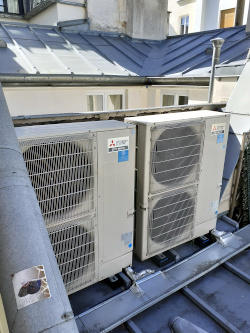
A DPE consists of:
- an estimate of energy consumption (in energy units) for heating, hot water production, air conditioning, etc., as well as an estimate of the building's greenhouse gas emissions (presented via energy and climate labels);
- recommendations for improvements to the building to save energy.
A DPE issued after July 1, 2021, is valid for 10 years. Any DPE issued before July 1, 2021, is no longer valid.
Article L126-38-1 of the CCH introduces a requirement to conduct an "energy audit"—a more in-depth assessment than a standard DPE—prior to the sale of properties with poor energy performance (as indicated by their DPE rating). The threshold for this rating will be lowered over time. This requirement does not apply to individual apartments within co-owned properties (condominiums).
Professionals are required to submit DPEs to a national database managed by ADEME (the French Agency for Ecological Transition), where they are indexed using a 13-character identifier. ADEME is making DPE (Energy Performance Diagnosis) data accessible.
In European regulations, the DPE is referred to as an "Energy Performance Certificate" (EPC). This term was not adopted in France—likely because, in 2006, when the European regulations were introduced, the acronym "CPE" was already being used for the *Contrat Première Embauche* (First Employment Contract).
Our Services
We prepare Energy Performance Certificates (DPE) for existing residential buildings by applying the 3CL calculation method. For other types of existing buildings, we use the energy bill-based method, drawing on data from the last three years. For new buildings, we utilize the results from the mandatory regulatory thermal study (e.g., RSET or RSEE files).
Preparing DPEs for large-scale structures—such as multi-unit residential buildings or commercial/tertiary properties—requires a specific, advanced certification known as "DPE with endorsement" (*DPE avec mention*), which we hold.
As of July 1, 2021, the 3CL calculation method has replaced the bill-based method for all residential properties, including older homes (built before 1948).
We conduct an on-site inspection of the premises. In the case of a DPE for a multi-unit residential building, and in accordance with current regulations, this inspection may be limited to a representative sample of individual apartments.
To ensure the most accurate DPE results, it is important for the owner to provide the professional with supporting documentation that describes the property's characteristics—particularly those that are not directly observable (such as wall insulation, etc.). Among the accepted documents are:
- work specifications,
- invoices for work performed,
- photographs of the work,
- equipment maintenance contracts,
- for multi-unit buildings, the building's floor area measurements or the heating-related share (tantième) allocated to the dwelling,
- ...
Statements provided by the owner are not accepted.
In the absence of information, the least favorable characteristics are assigned to the dwelling—for example, coal heating if the heating method is unknown.
©TEKIMMO 2002 - last site update : 11/2008